Continuing Care at Home Archives – Varsity Branding

Tag: Continuing Care at Home

The following is a recap from Varsity’s Roundtable, a weekly virtual gathering of senior living marketers and leaders from across the nation. For updates about future weekly Roundtable gatherings, submit your name and email address here. 

The senior living industry has spent decades preparing for the aging Baby Boomer generation. Now that demographic wave is arriving, and the numbers raise some serious questions about the industry’s ability to keep up. With independent living occupancy approaching capacity and demand projected to far outpace new construction, millions of older adults could find themselves without access to the housing, care and community they need.

Brad Paulis, Partner at Continuing Care Actuaries, joined Varsity’s weekly Roundtable to explore what he calls the demographic tsunami and its implications for the future of senior living. Drawing on demographic projections and industry trends, Brad discussed the growing shortage of senior housing, changing preferences around skilled nursing and why traditional development alone won’t meet future demand. He also challenged senior living leaders to think beyond their physical communities and explore new ways to serve older adults. Below are a few Fresh Perspectives from his discussion.

A PERIOD OF UNPRECEDENTED GROWTH

The U.S. population age 75 and older is projected to grow from fewer than 20 million in 2025 to 32–33 million by 2045. With independent living occupancy already around 94%, demographic demand is pushing communities toward capacity despite economic uncertainty.

THE INDUSTRY IS FACING A MASSIVE CAPACITY SHORTFALL

By 2035, senior housing could face a shortage of 1 million units, growing to 2 million by 2045. Over the next 20 years, cumulative unmet demand could leave nearly 6 million older adults without access to the housing, healthcare support and community they want. These projections already account for anticipated new construction.

CHANGING CARE PREFERENCES ARE RESHAPING SENIOR LIVING

Private-pay skilled nursing utilization is declining as older adults increasingly choose to receive additional support in their homes or independent living residences. This shift creates opportunities to repurpose underused skilled nursing space while challenging communities to accommodate residents with greater care needs.

TRADITIONAL CONSTRUCTION ALONE WON’T SOLVE THE SHORTAGE

Land availability, zoning restrictions, construction costs and development timelines make it impossible to build enough communities to meet projected demand. Senior living providers need to explore alternative service models, including Continuing Care at Home programs and other ways to bring healthcare, wellness and social connections to older adults beyond their campuses.

THE INDUSTRY MUST RETHINK HOW IT FULFILLS ITS MISSION

Most senior living organizations define their missions around serving older adults, not operating buildings. Boards and leadership teams need to start conversations now about expanding that mission, developing new partnerships and finding innovative ways to deliver the security, care and sense of belonging older adults need.

The desire to age in place is changing how older adults engage with senior living—and challenging communities to rethink when and how they connect with future residents. As a result, models like continuing care at home (CCaH) are gaining attention as a way to extend care beyond the campus while building earlier relationships.

On Varsity’s weekly Roundtable, Dr. Amanda Young, CEO of M.A. Longey Consulting, shared insights from her experience launching and operating these programs, including how they’re evolving and where they fit within the broader continuum. Below are a few Fresh Perspectives from her discussion.

EARLIER ENTRY POINT, STRONGER FUTURE PIPELINE

CCaH doesn’t cannibalize independent living demand, it captures prospects earlier. By engaging individuals years before they’re ready to move, communities can build relationships, strengthen waitlists, and ultimately convert more residents over time.

EDUCATION IS THE GROWTH BOTTLENECK

Interest in the model is growing, but adoption lags due to confusion. Consumers don’t know what it is, leaders don’t fully trust it, and the lack of a physical product makes it harder to explain, turning education into the biggest growth constraint.

THIS IS A NEW BUSINESS, NOT A SIDE HUSTLE

Programs that struggle are often under-resourced. Success requires dedicated staff, marketing investment, and leadership alignment because this isn’t an add-on, it’s an entirely new line of business with its own operational and financial model.

THE MODEL EXPANDS YOUR REACH—WITHOUT BUILDING

With demand for senior living far exceeding supply, continuing care at home offers a scalable way to serve more older adults without major capital investment. It extends your mission beyond your campus and into the broader community.

FLEXIBILITY IS THE FUTURE OF THE MODEL

The traditional life care structure isn’t reaching the middle market, but innovation is underway. Hybrid models, care coordination-only options, and waitlist-based programs are reshaping the offering to be more accessible and financially realistic.

RETHINKING THE CONTINUUM AS A CONNECTED JOURNEY

The most effective organizations don’t treat at-home and community living as separate choices. They position them as connected steps, allowing individuals to enter earlier, stay longer, and move seamlessly when the time is right. 

Varsity’s Roundtable is a weekly virtual gathering of senior living marketers and leaders from across the nation. For updates about future weekly Roundtable gatherings, submit your name and email address here. 

Artificial intelligence is quickly becoming part of the conversation across the aging services landscape, and CCaH organizations are beginning to explore what it might mean for marketing, operations and strategic decision-making. While many teams are still in the early stages of adoption, the pace of innovation is accelerating, making it increasingly important for leaders to understand where AI is headed and how it might support their work.

That was the focus of a recent presentation by Zack Collevechio, Senior Data Scientist at WildFig and Pavone Group, during Varsity’s most recent Age-in-Place Roundtable. Below are a few Fresh Perspectives from his discussion.

THE AI LANDSCAPE IS MOVING FAST – Major technology companies like OpenAI, Anthropic and Google are releasing new AI models at a rapid pace. Many of the most advanced tools available today didn’t exist just a few months ago, which means the capabilities of AI are improving almost continuously.

NOT ALL AI TOOLS ARE THE SAME – Platforms like ChatGPT, Claude and Google’s Gemini each have different strengths. Some models are better for research, others for writing or media generation. Teams may benefit from experimenting with multiple tools rather than relying on a single platform.

AI CAN HANDLE MORE COMPLEX TASKS – While many people still think of AI as a chatbot that writes emails or blog posts, today’s models can analyze large documents, summarize complex information and support more advanced workflows.

CONTEXT, MEMORY AND AGENTS ARE CHANGING THE GAME – New AI capabilities include larger context windows (which allow tools to process far more information), built-in memory that remembers preferences and templates, and “agentic workflows” where AI can complete tasks more independently.

EXPERIMENT, BUT VERIFY – AI is a powerful tool, but it’s not perfect. Hallucinations can still occur, particularly with niche topics, so human review and fact-checking remain essential.

PRIVACY AND DATA PROTECTION MATTER – Free AI tools may use prompts and inputs to train their models, while paid subscriptions often offer stronger privacy controls. Organizations should consider how data is handled when selecting tools.

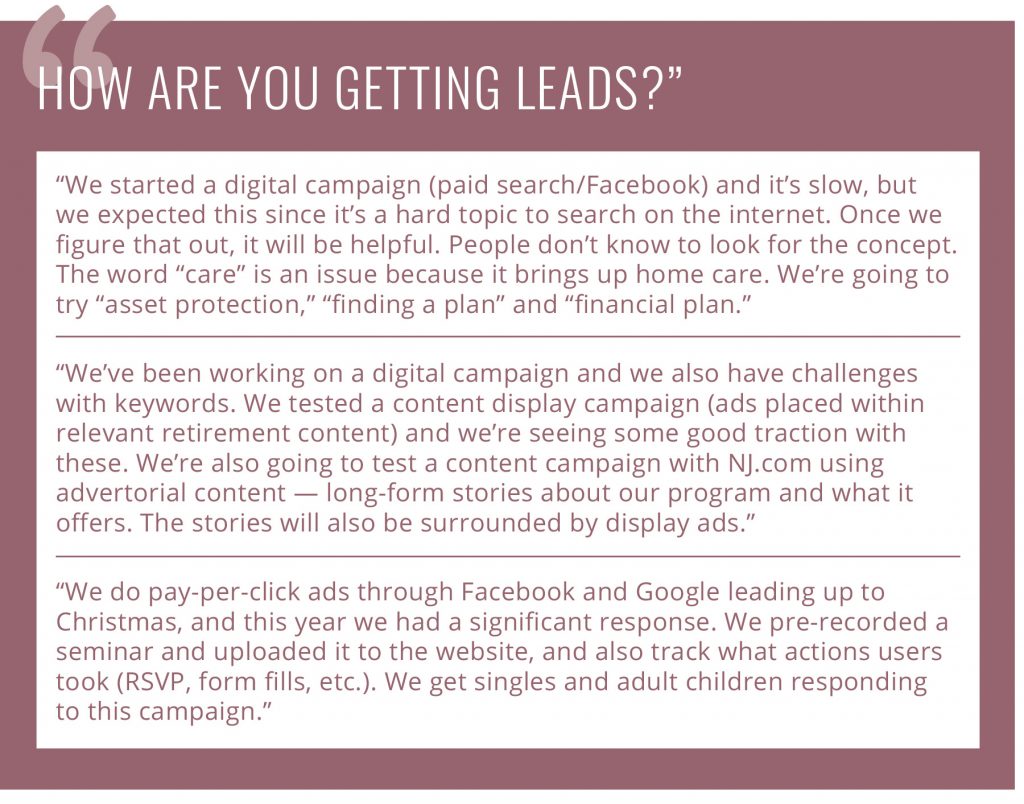
At our 2nd monthly Continuing Care at Home Roundtable, we all shared our ideas about generating leads, cross-promoting community living and overcoming objections.

Check out the highlights below, and feel free to join us for our next roundtable discussion in April.

Please join our next Continuing Care at Home Roundtable on Wednesday, April 7, at noon ET.

For login information, email DDunham@VarsityBranding.com.


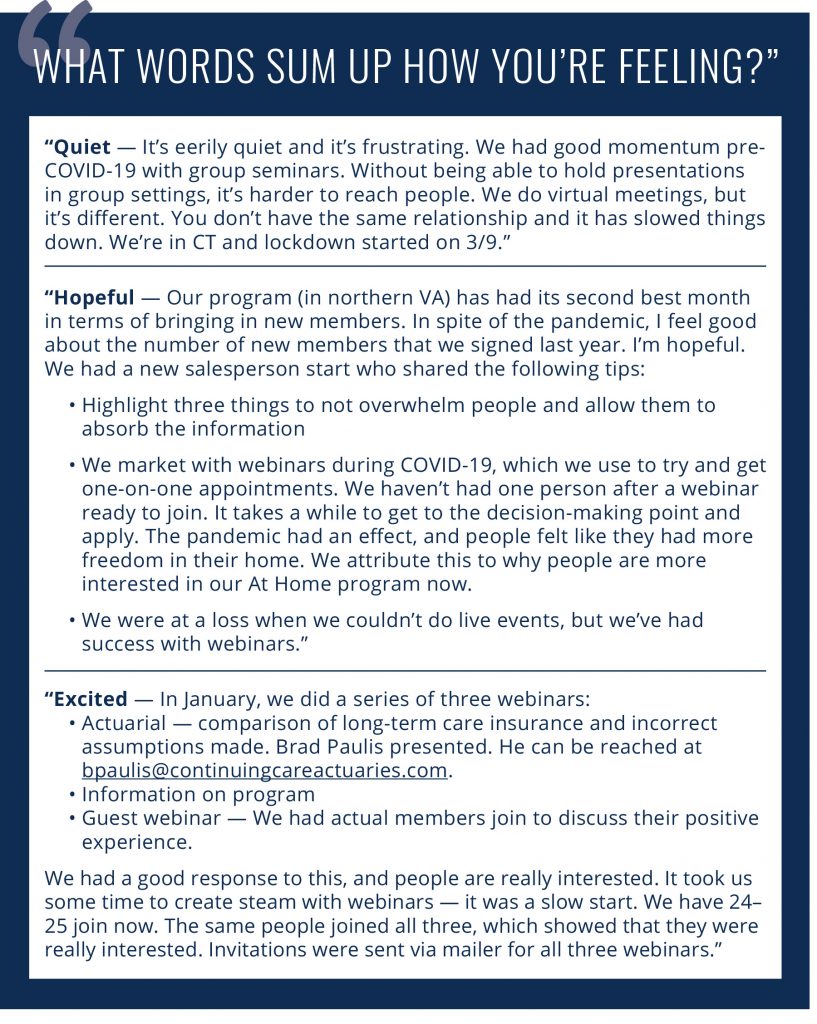
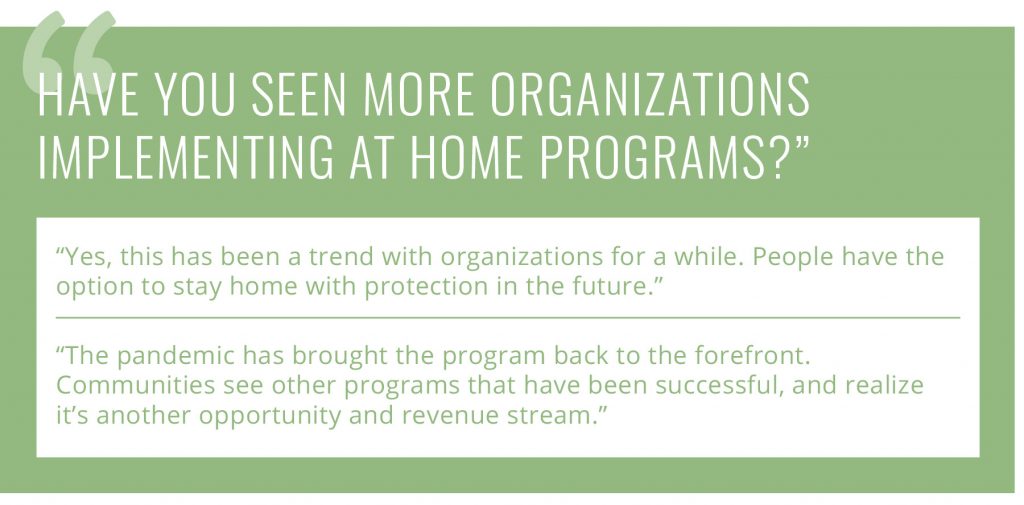
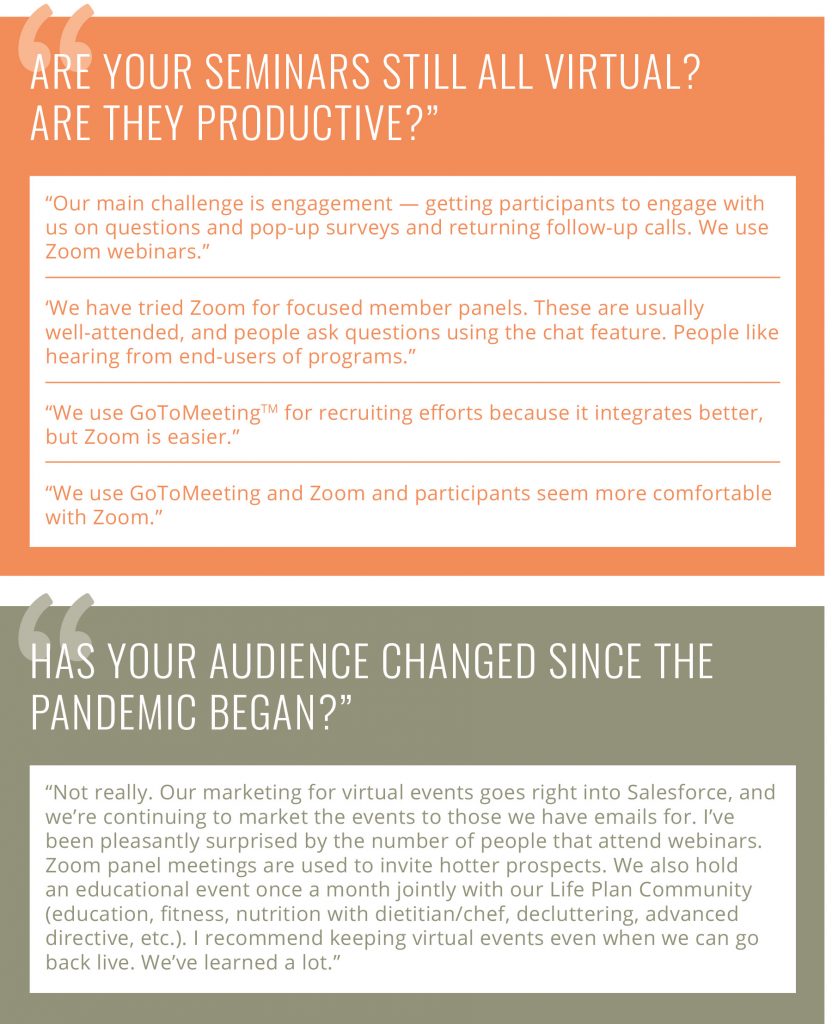
Last Wednesday, we held our first monthly virtual Continuing Care at Home Roundtable! A group of professionals from across the country pooled their knowledge and shared sales and marketing tactics that are succeeding during COVID-19.

Please join us for our next Continuing Care at Home Roundtable on Wednesday, March 3, 2021, at noon ET.

For login information, email DDunham@varsitybranding.com. 

Subscribe to
Varsity Prime

Varsity has a podcast!

Our new podcast about longevity and aging offers fresh perspectives and interviews with industry leaders.